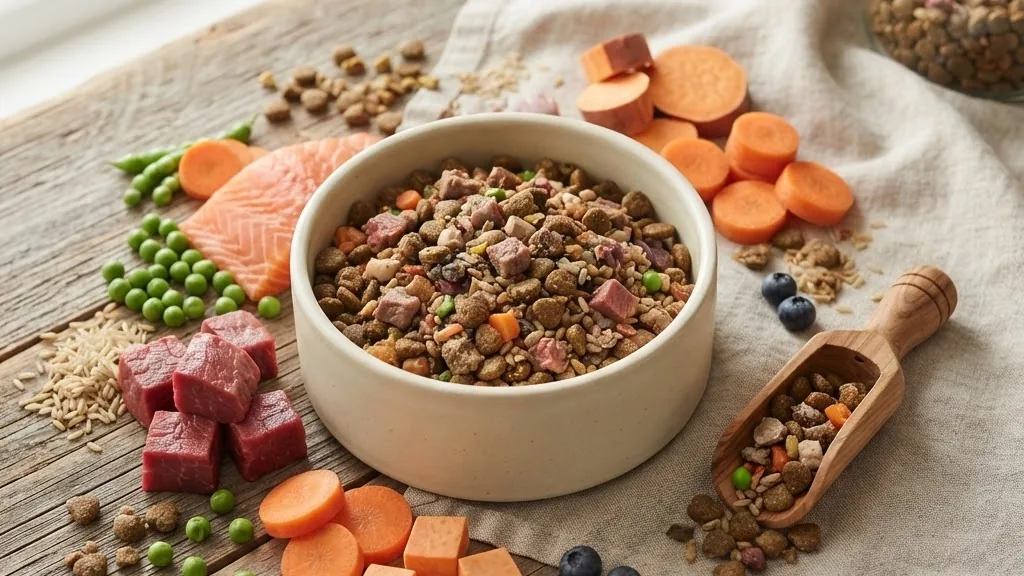
Showtime dog food shows up on feed-store shelves with bags labeled 27/20, 24/20, and 21/12, and those numbers confuse a lot of owners. They are not random. They are the key to understanding whether this budget-friendly, American-made performance food is right for your dog, or whether you are paying for energy density your pet does not need. This review decodes the formulas, looks honestly at the ingredients, and measures the brand against the standards veterinary nutritionists actually use.
The aim is a fair, sourced verdict rather than hype or a quick star rating. The only measure that truly matters is whether a diet is complete and balanced for your dog’s life stage, and whether your individual dog does well on it. This article is educational and does not replace advice from your own veterinarian, who knows your dog’s health and history.
What Showtime is
Showtime is a United States-made dog food sold mainly through feed and farm stores rather than big-box pet retailers. It sits in the budget-to-mid price tier and is built around performance and working-dog formulas, the kind marketed to hunters, sporting breeds, and high-activity animals. You will usually find it in large 50-pound bags, which is part of its appeal to owners feeding multiple or hard-working dogs.
The brand is best known for its protein-and-fat formula naming, the 27/20 style label that tells you the nutritional intensity of each bag at a glance. Understanding that code is the single most useful skill for choosing the right Showtime product, so it is worth a close look. It is also why two owners can have very different experiences with the same brand: one matched the formula to a working dog and saw great results, while another fed a performance bag to a lap dog and watched it gain weight. The food was not the variable; the match was.
Decoding 27/20, 24/20, and 21/12
The two numbers on a Showtime bag are the guaranteed minimum percentages of crude protein and crude fat, in that order.
- 27/20 means about 27 percent crude protein and 20 percent crude fat. This is the performance formula, aimed at hard-working and highly active dogs that burn a lot of energy.
- 24/20 means roughly 24 percent protein and 20 percent fat, a step down for active but not extreme dogs.
- 21/12 means about 21 percent protein and 12 percent fat, a maintenance-level formula for lower-activity adult dogs.
The higher the numbers, the more energy-dense the food. A couch-companion dog fed a 27/20 performance diet can gain weight, while a working hound on a 21/12 maintenance food may run short on fuel. Matching the formula to the dog’s real activity level is the whole point of the numbering system.
What is in the bag
Showtime is a grain-inclusive dry food. Its recipes typically lead with poultry and porcine meal, a named meat concentrate, as the main animal-protein source, followed by grains such as rice, barley, oats, corn, and wheat.
A few honest observations about that ingredient profile:
- The main protein is a meat meal, not fresh meat. That is common in performance kibble and not a flaw on its own, as the next section explains.
- Corn and wheat appear in the formula, sometimes high on the list. These are inexpensive grains. They are not toxic and most dogs digest them fine, but they are lower-cost ingredients that contribute to the budget price.
- It is grain-inclusive, not grain-free. For most dogs that is perfectly appropriate; grains are a normal, digestible energy source.
If your dog has shown digestive sensitivity on past foods, knowing how to read this kind of label is the same instinct that helps when a dog is throwing up white foam or reacting to a diet change.
Meat meal versus fresh meat
The phrase “poultry and porcine meal” sounds less appealing than “fresh chicken,” but it is worth understanding before you judge it.
Meat meal is meat that has had most of its water and fat removed and been rendered into a concentrated powder. Because fresh meat is mostly water, a meat meal contains far more protein by weight, on the order of 300 percent more protein than the same weight of fresh meat. So a meal listed first can actually deliver more protein to the finished kibble than a fresh meat listed first that shrinks once cooked.
The real question is not meal versus fresh, but the quality and source of that meal. A named meal like poultry meal is more transparent than a vague “meat meal” or “animal by-product meal.” Showtime’s use of named poultry and porcine meal is reasonable for its price tier; the open question is the sourcing detail, which is exactly what the evaluation method below is for.
Reading the guaranteed analysis
The protein-and-fat code is a headline, but the bag also carries a guaranteed analysis panel, and learning to read it tells you more than any marketing line. Four figures matter most.
- Crude protein (minimum). The first number in the formula name. For a working dog, the higher protein in a 27/20 supports muscle and recovery; for a pet dog, 21 percent is usually plenty.
- Crude fat (minimum). The second number, and the main energy driver. Fat is calorie-dense, so a 20 percent fat food packs far more energy per cup than a 12 percent one.
- Crude fiber (maximum). Usually a few percent. Very high fiber can dilute calories; very low can affect stool quality.
- Moisture (maximum). In dry food this is around 10 percent, so almost the whole bag is nutrients rather than water, the opposite of canned food.
One number the panel does not always show is calories per cup. Energy content is what actually drives weight, so if it is not printed, ask the manufacturer. Knowing the calories per cup lets you feed by your dog’s real needs instead of guessing from the scoop.
Performance food and a working dog’s real needs
Showtime’s performance formulas exist for a specific kind of dog: one that runs, hunts, herds, or trains hard for hours. These dogs can burn well beyond a pet dog’s daily calories, and a 27/20 food is designed to pack that energy into a manageable volume of kibble.
But the formula is only half the equation. A hard-working dog also needs careful hydration and recovery, and owners should watch for signs of overexertion such as heavy panting that continues at night, which can signal a dog that has been pushed too hard or is struggling to recover. Energy-dense food supports performance; it does not replace sensible workload management, rest, and water.
For the average companion dog with a daily walk, a performance formula is usually more energy than needed. That is not a knock on the food; it is a reminder to match the formula to the dog. The 21/12 maintenance option exists precisely for these lower-activity dogs.
Complete and balanced: the line that matters
Before any opinion about ingredients, check one thing on the bag: the nutritional adequacy statement.
In the United States, the Association of American Feed Control Officials (AAFCO) sets the nutrient profiles behind the “complete and balanced” claim. The FDA’s Center for Veterinary Medicine explains that a complete-and-balanced food provides all the nutrients a dog needs in the right proportions and can be fed as the sole diet. Confirm that the specific Showtime formula you are buying carries this statement and names the life stage it suits, whether growth, adult maintenance, or all life stages.
A performance formula is usually aimed at adult, active dogs, so it may not be formulated for the higher needs of growing puppies. Read the bag rather than assuming.
Judging it the way a nutritionist would
The World Small Animal Veterinary Association (WSAVA) publishes Global Nutrition Guidelines that give owners a practical way to size up any brand. Applied to Showtime, the key questions are:
- Does the maker employ a qualified nutritionist, such as someone with a PhD in animal nutrition or a board-certified veterinary nutritionist?
- Are the formulas tested through AAFCO feeding trials, or only formulated to meet a profile on paper?
- What quality control and sourcing standards does the mill use?
- Will the company share the calorie content and full nutrient analysis on request?
For a regional, budget-tier food, these answers are not always easy to find, and that is itself useful information. If transparency matters to you, contact the manufacturer directly and ask. A brand that answers clearly earns more trust than one that does not.
Which dog each formula suits
Showtime’s range only makes sense when matched to the dog.
| Formula | Protein / fat | Best suited to |
|---|---|---|
| 27/20 Performance | ~27% / 20% | Hard-working, hunting, sporting, very active dogs |
| 24/20 | ~24% / 20% | Active adult dogs with regular exercise |
| 21/12 | ~21% / 12% | Lower-activity adult dogs at maintenance |
Feeding a high-energy formula to a low-activity dog is a common cause of unwanted weight gain, while underfeeding energy to a working dog leaves it short on fuel. The numbers exist to prevent both mistakes.
The honest trade-offs
A fair review names the good and the not-so-good.
Strengths. Showtime is affordable, energy-dense, and widely available through feed stores, which makes it a practical option for owners of active or working dogs on a budget. The performance formulas deliver the protein and fat that hard-charging dogs need, and the named meat meal provides a concentrated protein source.
Trade-offs. It is grain-inclusive with lower-cost grains like corn and wheat, its main protein is a meal rather than fresh meat, and independent reviewers tend to rate it modestly. One widely read review site rates the dry line around 1.5 out of 5 stars, largely on ingredient-quality grounds. That rating reflects ingredient sourcing more than safety, and a food can still be complete and balanced and suit a particular dog despite a low third-party score. The takeaway is to weigh price and availability against ingredient quality for your situation.
Storing a 50-pound bag without losing freshness
Buying in 50-pound bags saves money, but a big bag also sits open for weeks, and kibble freshness matters for both palatability and nutrition. The fats that make performance food energy-dense are also the first thing to go rancid once exposed to air, light, and heat.
- Keep it in the original bag. The bag is lined to protect the food; pour it, bag and all, into a bin rather than tipping loose kibble onto plastic that holds old oils.
- Seal and store cool. Roll and clip the top after each use, and keep the bag somewhere cool and dry, away from a hot garage or direct sun.
- Use it within a reasonable window. Try to finish an opened bag within about six weeks so the fats stay fresh, especially for the higher-fat 20 percent formulas.
- Watch for off smells. A sharp, paint-like odor means the fat has oxidized; if the food smells off or your dog suddenly refuses it, stop feeding from that bag.
These habits cost nothing and protect the value of buying in bulk, which is one of Showtime’s main advantages.
How to switch foods safely
If you move your dog onto Showtime, transition gradually. AAFCO and veterinary guidance recommend a change over about 7 to 10 days to avoid digestive upset.
- Days 1 to 3: about 75 percent old food, 25 percent Showtime.
- Days 4 to 6: roughly half and half.
- Days 7 to 9: about 25 percent old food, 75 percent new.
- Day 10 onward: 100 percent Showtime if your dog has handled the change well.
Watch for loose stools, vomiting, low appetite, or low energy during the switch, and slow down or consult your vet if any of these persist.
How Showtime compares to premium performance foods
It helps to place Showtime in context rather than judging it in a vacuum. Premium performance foods, the ones costing two or three times as much, typically differ in three ways.
- Protein sources. Premium lines often lead with multiple named fresh meats and named meals, and avoid corn and wheat. Showtime leans on a named meat meal plus lower-cost grains to hit its price.
- Formulation backing. The most rigorous brands employ board-certified nutritionists and run AAFCO feeding trials. Budget regional foods more often formulate to a nutrient profile on paper, which still meets the standard but carries less evidence.
- Price per feeding. This is where Showtime wins. For an owner feeding several active dogs, the cost difference over a year is substantial, and a correctly matched, complete-and-balanced budget food can keep a working dog in good condition.
The honest framing is that you generally get what you pay for in ingredient quality, but “more expensive” is not automatically “necessary.” A healthy, active dog that does well on a complete-and-balanced Showtime formula is not being shortchanged simply because the bag was cheaper. The proof is in the dog’s body condition, coat, energy, and stools over time, not the price tag.
The verdict
Showtime is a budget, grain-inclusive, performance-oriented dog food whose main strength is energy density at a low price, and whose main trade-offs are ingredient quality and modest third-party ratings. For an active or working dog whose owner needs an affordable, easy-to-find option, a correctly matched Showtime formula can be a reasonable, functional choice, provided the specific bag is labeled complete and balanced for that dog’s life stage.
As with any food, the right decision comes from a method, not a number on a marketing page: match the formula to your dog’s activity, confirm the complete-and-balanced statement, ask the maker the WSAVA questions, transition slowly, and judge by your dog’s coat, weight, energy, and stools over a few weeks. If your dog thrives and the budget fits, it works; if not, a food that better matches your priorities is the smarter spend.
One last reminder worth repeating: a low third-party star rating is not the same as an unsafe food. Ratings on review sites weigh ingredient quality heavily, which is a fair lens but not the only one. A working dog on a budget, fed a complete-and-balanced 27/20 formula it digests well, can be in excellent condition. Let your veterinarian and your dog’s actual health, not a single online score, settle the question for your specific animal.
Frequently asked questions
What does 27/20 mean on Showtime dog food?
It means the food guarantees about 27 percent crude protein and 20 percent crude fat. Higher numbers signal a more energy-dense, performance-oriented formula for very active dogs, while lower numbers like 21/12 suit lower-activity adults.
Is Showtime dog food good for puppies?
Only if the specific formula is labeled as suitable for growth or all life stages. Many performance formulas are aimed at adult, active dogs. Check the nutritional adequacy statement on the bag, and ask your vet about the right diet for a growing puppy.
Is Showtime dog food grain-free?
No. Showtime is grain-inclusive, using grains such as rice, barley, oats, corn, and wheat. For most dogs that is appropriate, since grains are a normal, digestible energy source.
Where can I buy Showtime dog food?
It is sold mainly through feed and farm stores and some online pet-supply retailers, typically in 50-pound bags. Availability varies by region, so check local feed stores or the manufacturer’s stockist list.
Is Showtime dog food complete and balanced?
Check the bag. A food meant to be fed as the sole diet will carry an AAFCO complete-and-balanced nutritional adequacy statement for a named life stage. Confirm this for the exact formula you plan to feed.
Why do some reviews rate Showtime low?
Low ratings usually reflect ingredient quality, such as the use of corn, wheat, and meat meal, rather than safety. A food can still be complete and balanced and work well for a particular dog despite a modest third-party score. Decide based on your dog’s needs and how it does on the food.